
Built in Sugar Land, Texas
Sell a dental practice in Texas
A Texas dental practice is priced the way any other one is: adjusted EBITDA times a multiple that depends on the buyer, 3×–4.25× for one dentist buying one office in 2025, more for a group or a platform buyer. What Texas changes is who those buyers are, how they have to be structured, and what you keep after the sale.
Dental Practice Connect is a Texas dental practice brokerage based in Sugar Land, outside Houston. This page covers the Texas specifics, then the same thing every seller needs first: the number, from your own books, for free.
The valuation account is free. No card. Read-only access to your books, always.
What Texas changes, and what it does not
Three things are specific to a Texas sale. First, ownership: Texas law requires a dental practice to be owned by a licensed dentist, so a corporate buyer does not buy the practice outright; a dental service organization typically holds the non-clinical assets under a management agreement with a licensed dentist, and your attorney confirms the structure. Second, there is no state income tax in Texas, so the state's share of your proceeds is zero; federal capital gains and the allocation of the price between goodwill, equipment and a non-compete are the tax questions that matter, and they are questions for your CPA. Third, the lease: Dental Practice Connect does not negotiate leases or real estate, so in our sale the lease and any building sit with your attorney or a licensed real estate broker, outside our engagement and our fee.
What does not change is the arithmetic. The multiple a Texas buyer pays comes from the same national transaction data as everywhere else, and the eight things they discount are the same eight things. If you sell with us, the fee is 5% at closing, nothing before.
| Buyer | EBITDA multiple (low – median – high) | Share of collections |
|---|---|---|
| One dentist buying one office | 3× – 3.5× – 4.25× | 60% – 75% – 95% |
| A partner buying in | 3.3× – 3.85× – 4.68× | 66% – 83% – 105% |
| A platform or private-equity buyer | 4× – 6× – 8× | 60% – 75% – 90% |
Where does your practice sit today?
An instant range by buyer type. The multiples are national transaction data; the buyer pool is local, and the sections below cover that.
How we get to a number
Buyers price a practice on EBITDA. Earnings after a market-rate dentist. Times a multiple. The multiple depends on the buyer. And on how many offices. We use 2025 transaction multiples. Same table as the app. Adjusted for specialty.
- Individual buyer — a dentist buying one practice. Most single offices sell this way.
- Partnership — an associate buying in. Or two dentists together.
- DSO / platform — pays for scale. Every multi-location practice. Single offices above about $1.2M.
DPC valuation dataset (2020–2025 dental transactions), 2025 rows.
Who is buying Texas practices
Each buyer type prices the same office differently, and in Texas the structure matters as much as the price. A platform offer in Houston or Dallas is usually cash at close plus equity in the group, with you staying on under an employment agreement; an individual buyer in a smaller market is usually an SBA-financed purchase with a short transition. Put both in today's dollars before comparing them.
- An individual dentist or your own associate: 3×–4.25× adjusted EBITDA, financed, one office
- A partner buying in: 3.3×–4.68×, and you keep a share and the chair
- A group or platform buyer: 4×–8× at scale, structured through a management agreement, part of the price as equity
Preparing a Texas practice for sale
The same work that moves any practice to the high end of its range, with two Texas notes: a buyer financing through an SBA lender will want three years of reconciled books and a lease with term left, and a practice with a large Medicaid share will be asked how that share has moved as the state's program has changed.
- Three years of clean, reconciled financials with documented add-backs
- Overhead toward 60% of collections
- Five or more years of lease term or options, or the building itself
- An associate or hygiene team that stays after the transition
- A real active-patient count and steady new-patient flow
- A payer mix a buyer can underwrite: fee-for-service and strong PPO schedules
What every buyer discounts
The app scores each of these from your own data and prices it, so you know which ones are worth fixing in the year before you sell.
- Financial quality: books that tie out, add-backs a buyer will accept, and a margin that holds up
- Patient base: active patients seen in the last 18 months and new-patient flow, not the chart count
- Staff and key-person risk: how much production leaves with you, and whether the team stays
- Payer mix: fee-for-service and strong PPO schedules versus heavy write-offs at the same collections
- Capacity: open operatories, open days and unscheduled treatment a buyer can execute in year one
- Facility and lease: years of term or options left, rent as a share of collections, equipment age
- Market: the demographics and competition around the office, which no amount of work moves
- Transition: how long you will stay, and how much of the referral base follows the practice rather than you
What happens after you create the free account
Get your Texas practice valued this week, from your own books
The account runs on an uploaded P&L or a read-only QuickBooks connection, and it stays free. A practice-management connection through Sikka — production, collections, providers and payers — is something we set up with you when you sell with us.
- 1
Create your free account
Three short screens: you, your practice, your numbers. About two minutes. Nothing is published anywhere, and no card is asked for.
- 2
Connect QuickBooks, or upload a P&L
Connect QuickBooks Online and we read your chart of accounts and Profit & Loss. The connection only ever reads; nothing in your books is changed. No QuickBooks? Upload the Excel, CSV or PDF export your accountant already sends you.
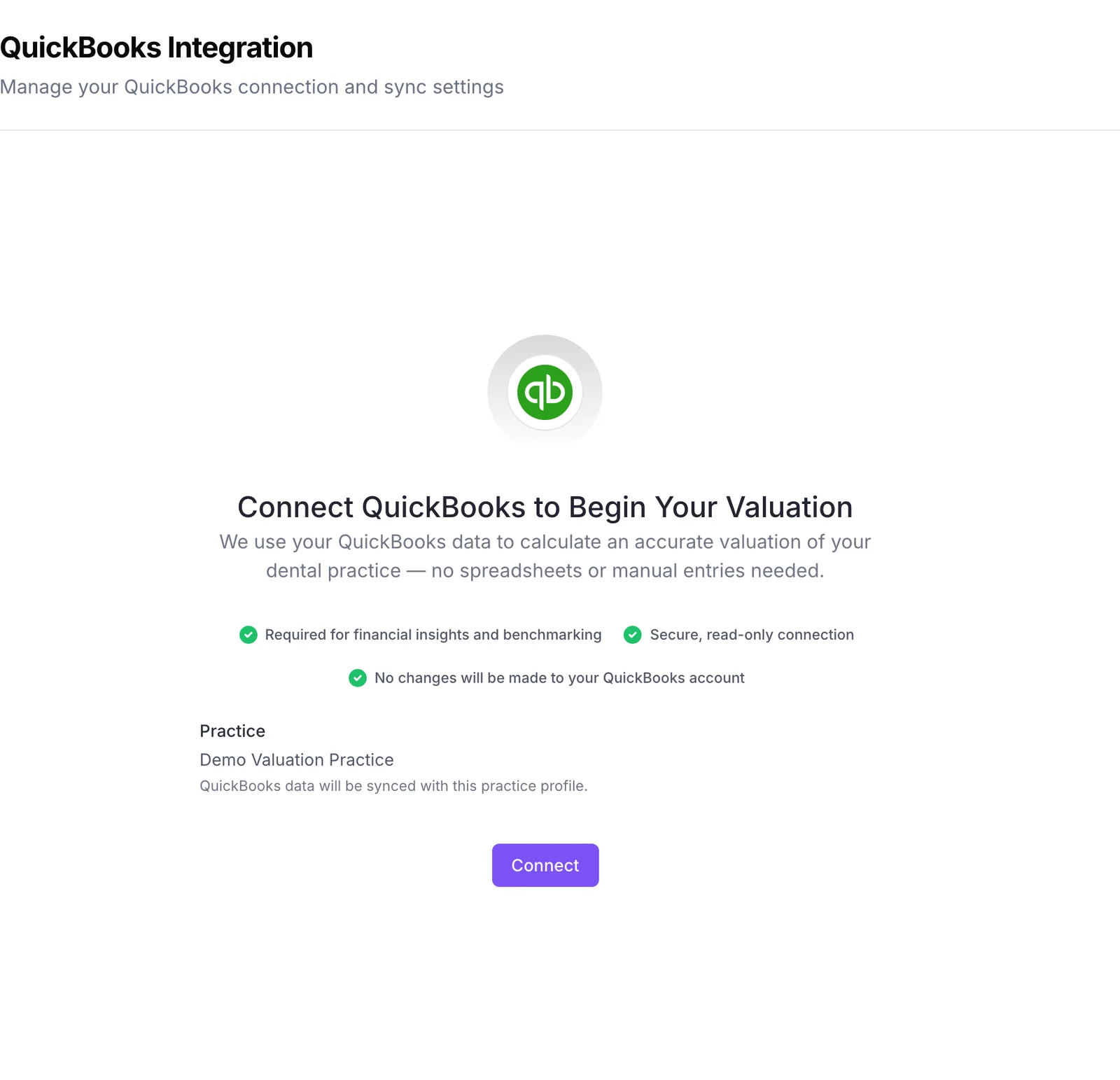
QuickBooks: a read-only connection. - 3
We classify the accounts and find the add-backs
Every account is mapped to a dental category and compared with industry benchmarks. Owner add-backs are called out line by line, and you can review every mapping.
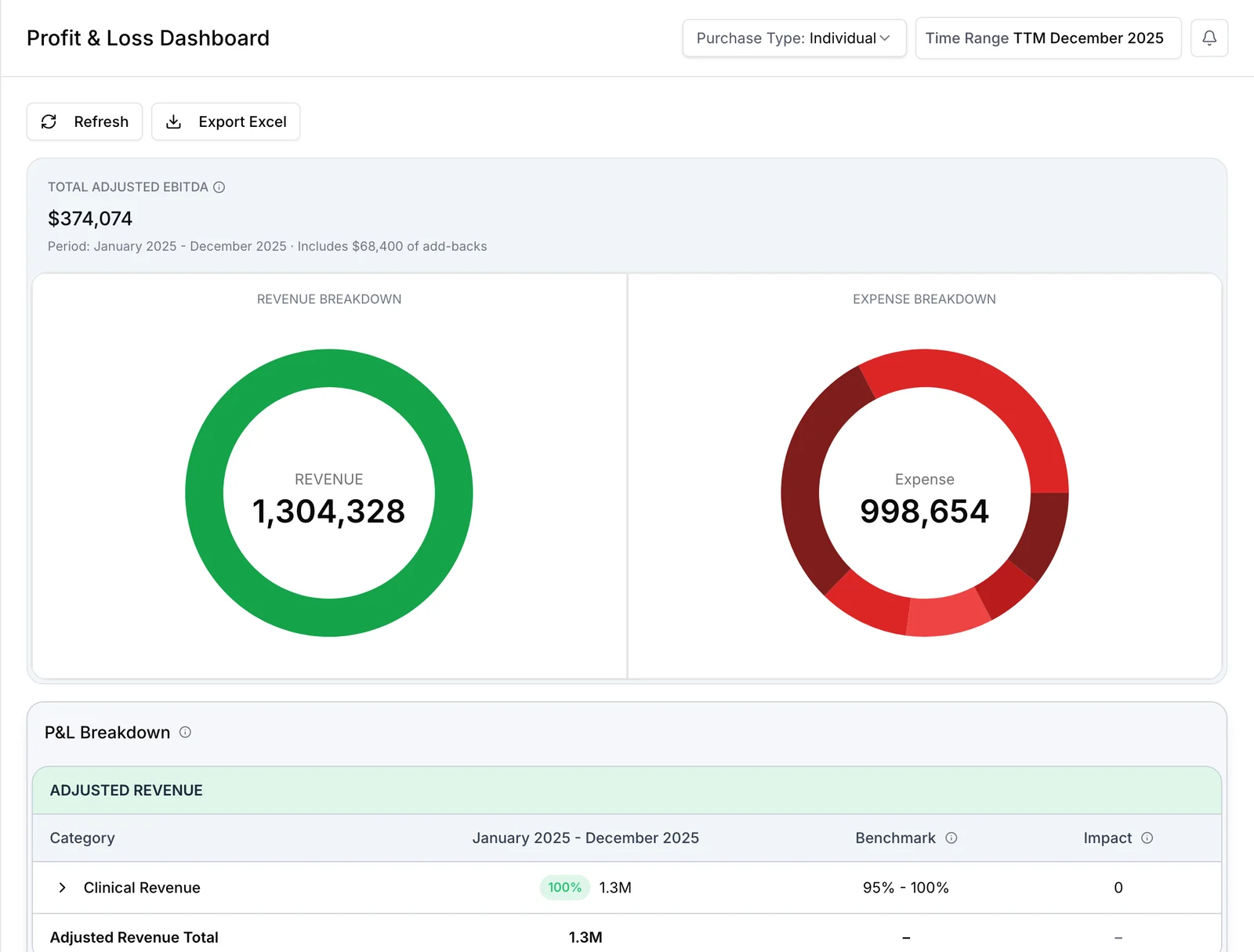
Profit & Loss, benchmarked line by line. - 4
Your valuation and scorecard appear
A value range by buyer type on your adjusted EBITDA, charted month by month, and a Practice Health score with the three levers worth the most to you this year. It updates every time your books do.
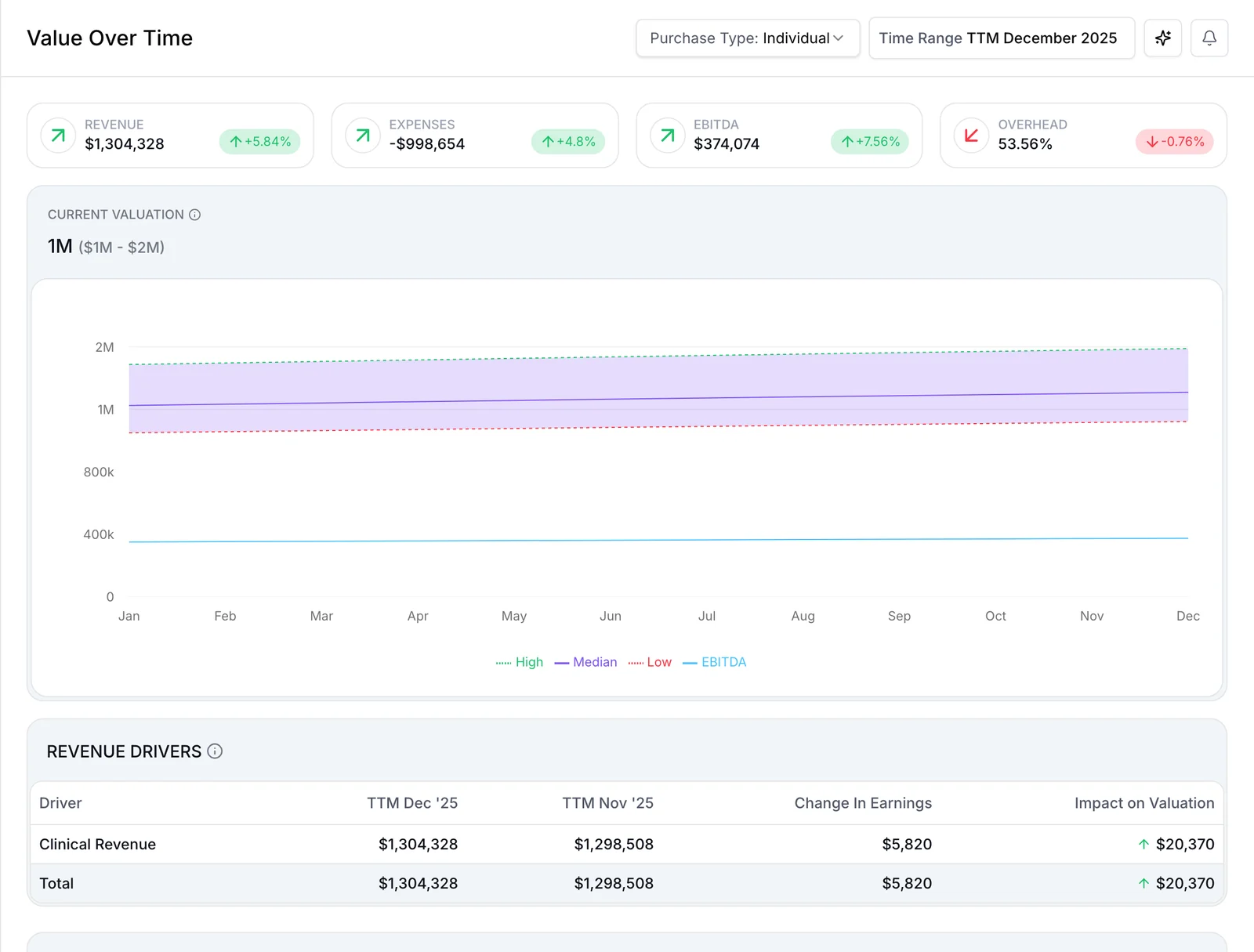
Value over time, by buyer type.
Questions from Texas owners
Can a DSO buy my dental practice in Texas?
Not the clinical practice itself. Texas law requires a dental practice to be owned by a licensed dentist, so a dental service organization typically buys the non-clinical assets and operates under a management agreement with a licensed dentist. The economics can still be a full sale; the paperwork is what differs. Have a Texas healthcare attorney confirm the structure.
Who handles the lease in a Texas practice sale?
Your attorney, or a licensed real estate broker. Dental Practice Connect does not negotiate leases or real estate, so the lease and any building are carved out of our engagement and our fee and handled by your attorney alongside the rest of the closing.
What taxes do I pay when I sell a dental practice in Texas?
Texas has no state income tax, so there is no state tax on the proceeds. Federal tax depends on how the price is allocated between goodwill, equipment, accounts receivable and a non-compete, and on how long you have owned the practice. That allocation is negotiated with the buyer and is a question for your CPA before you sign a letter of intent.
Are Texas dental practices worth more than the national average?
The multiple comes from national transaction data, 3×–4.25× adjusted EBITDA for one dentist buying one office, and does not carry a Texas premium. What differs is the buyer pool: the four large metros have more group and platform buyers competing, which is where the higher multiples get paid.
Do you only work with Texas practices?
The brokerage works in Texas only, for now. The valuation account values practices in every state from their own books, free, and that is where most owners start.
What is actually free?
The instant estimate on this page is free and needs no account. The full valuation account is free too: create it, upload a P&L or connect QuickBooks read-only, and the valuation, the benchmarked P&L and the scorecard are yours, with nothing published and no card asked for. The only fee on this site is the brokerage fee, paid at closing if you choose to sell the practice with us.
Who sees my numbers?
You, and anyone you invite. Nothing is published. The instant estimate runs in your browser and submits nothing unless you ask for it by email; the app keeps your financials behind your login.
Selling in Texas? Tell us where you are.
Houston, Dallas, Austin, San Antonio or anywhere in between. One person reads it and replies with the range for your practice and what would move it.
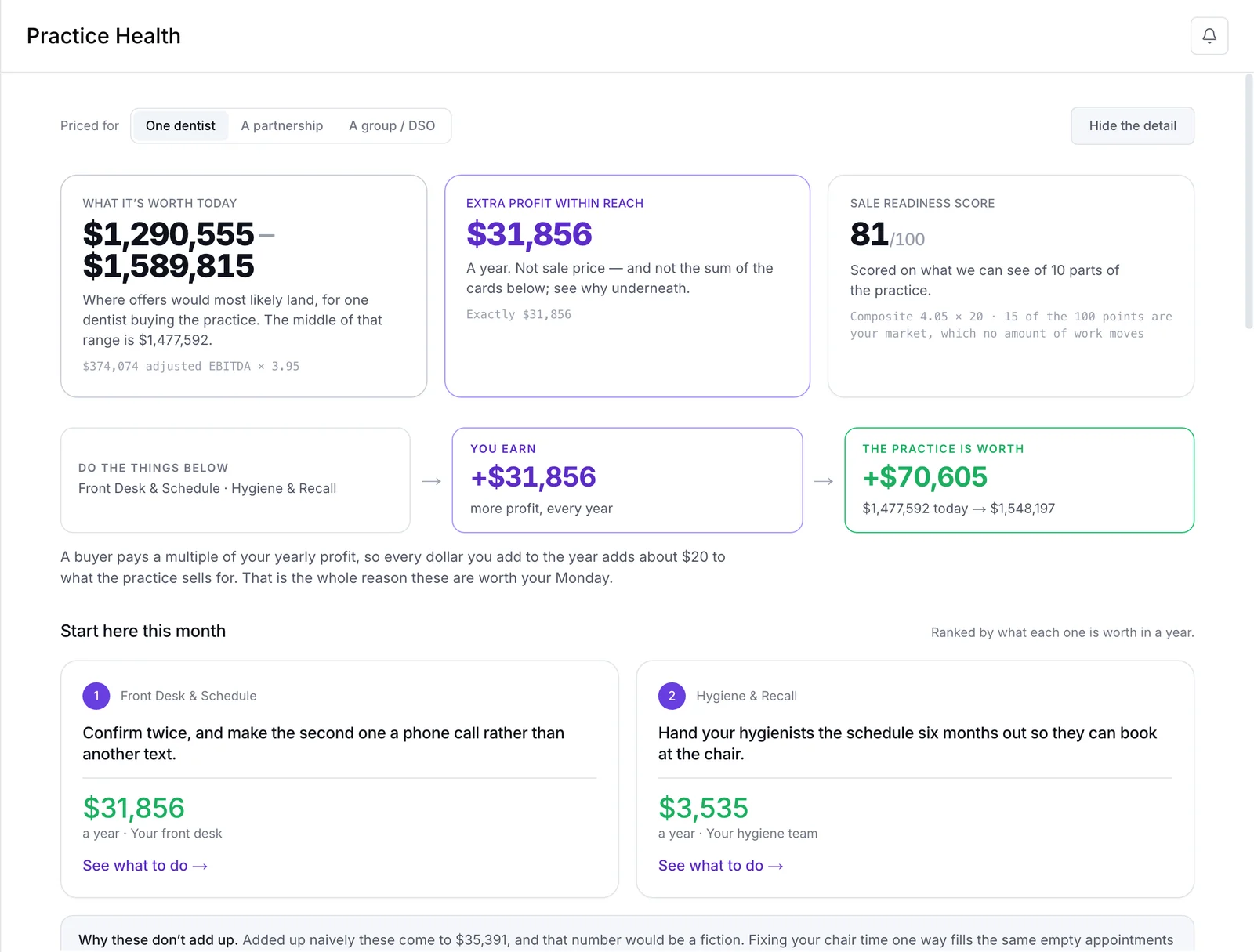
Keep reading
Sell a dental practice
Who buys, what each buyer pays, the timeline that protects your price, and a DSO offer vs. a private sale.
Dental practice valuation
How a practice is priced: adjusted EBITDA, the multiple by buyer type, and what buyers discount.
What's my dental practice worth?
The short answer, the five numbers that decide it, and a free range in about a minute.
How selling with us works
The service, step by step, from the valuation to closing.
2025 dental practice multiples
The transaction table behind every number on this page.